
CFD Modelling for Process Engineering and Equipment Design
At DOCAN Engineering Consultants, we often apply Computational Fluid Dynamics (CFD) in science and engineering to tackle complex process challenges. One of our clients operates a process where melting and freezing are critical. Designing equipment correctly, safely, and commercially viable requires deep technical knowledge of the equipment and how it behaves under real-world conditions.
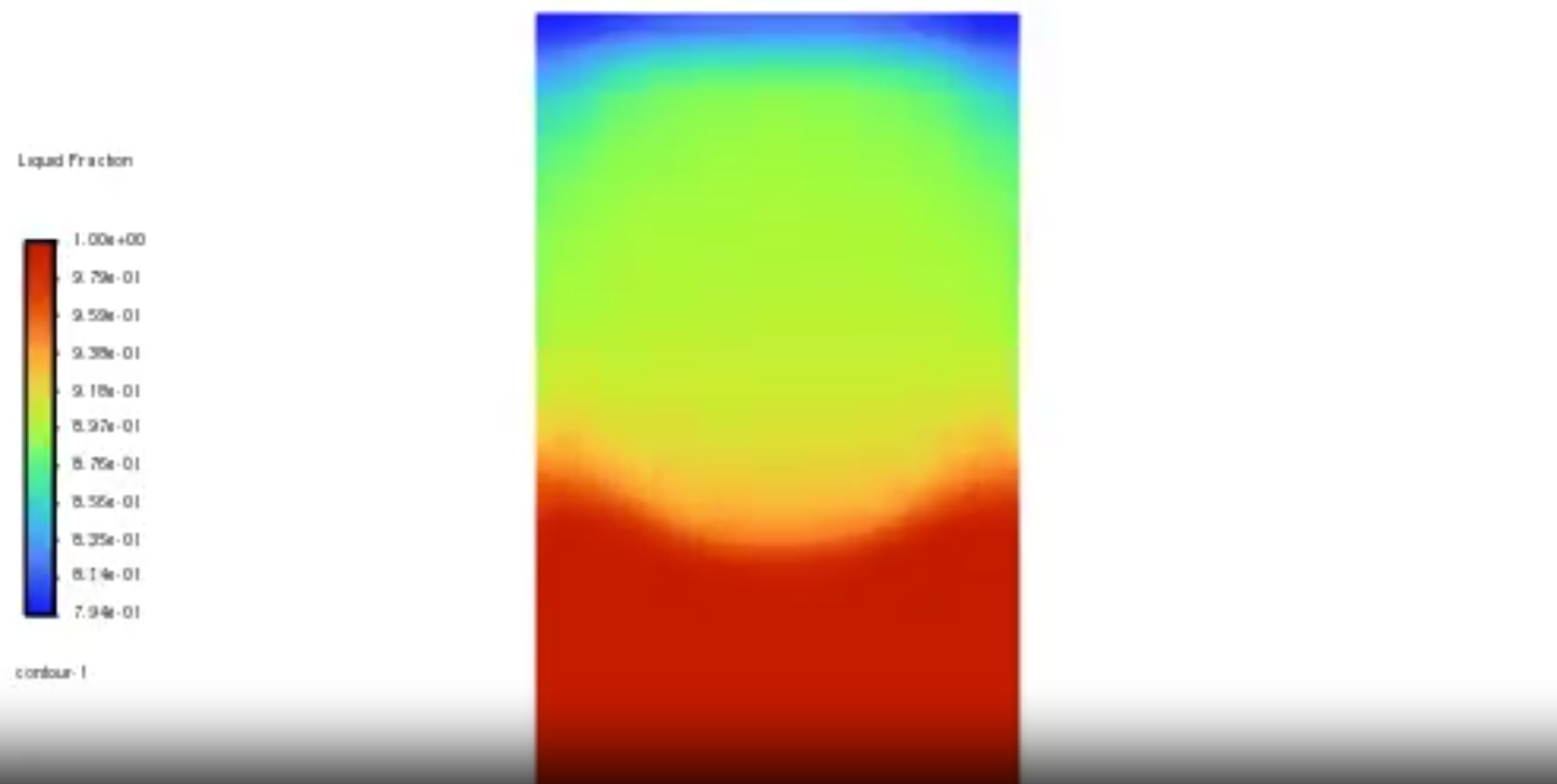
In a CFD benchmark planar test case, we model a ramping heat flux originating from electrical resistance. The fluid, initially in the solid phase, is subject to the latent heat of freezing, allowing us to monitor how it transitions into the liquid state. As the simulation progresses, the addition of buoyancy effects captures how the fluid naturally circulates and transfers heat, aiding the melting process. Observers will notice that no recirculations occur initially, highlighting the pure physics of the system.
For context, the latent heat of fusion for water is 334 kJ/kg, and the energy required to convert water to steam is 2260 kJ/kg. For lead, these values are 22.4 kJ/kg and 855 kJ/kg, respectively. Unlike sensible heat, latent heat occurs at a nearly constant temperature, which is why a Gin and Tonic with ice stays cold as the ice melts before warming up afterward.
This model will evolve into a full 3D thermo-fluid CFD simulation, encompassing multiple equipment types to aid and validate OEM designs. It also supports the creation of technical data used by clients for equipment selection, safe operation, and performance verification.
For more information on chemical and process engineering or CFD at DOCAN:
- Website: Contact us here
- Email: info@docanco.com
- Phone: +44 (0)1606 212330